Plant Spacing Calculator
Find out exactly how many plants fit in your garden bed, hedge, row, or yard. See a clear layout map with exact plant spots, compare straight rows with zigzag patterns, and calculate how many packs or flats to buy.
2. Bed Size & Measurements
3. Planting Pattern & Spacing
Extra Options: Edge Space, Row Direction & Plant Orders
Popular Garden Bed Layouts in 1 Click
Pick any garden plan below to automatically load its dimensions, pattern, edge space, and plant spacing into the calculator above.
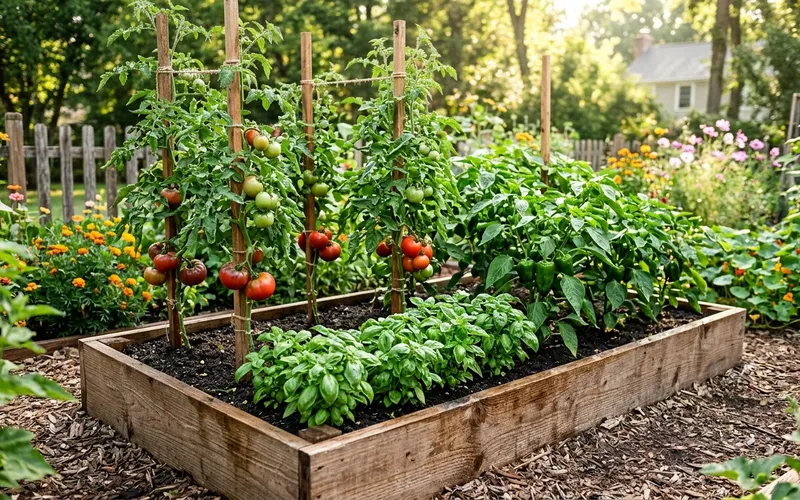
Kitchen Garden (Tomatoes, Bell Peppers & Basil)
Fits 4 staked tomatoes (spaced 24" apart), 6 bell peppers (spaced 18" apart), and basil around the edges with 6 inches of breathing room from the walls.

Square Foot Salad Bed (Head Lettuce & Spinach)
The classic square foot layout holding 16 heads of lettuce (1 per square foot) or up to 64 spinach plants (4 per square foot) with neat edge borders.

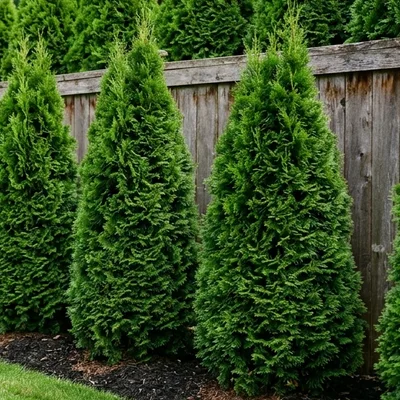
Double-Row Privacy Hedge (Arborvitae / Laurel)
A zigzag double row of shrubs spaced 3 feet apart. Fills into a thick green privacy screen much faster than a single straight line.

Flowering Perennial Bed (Zigzag Pattern)
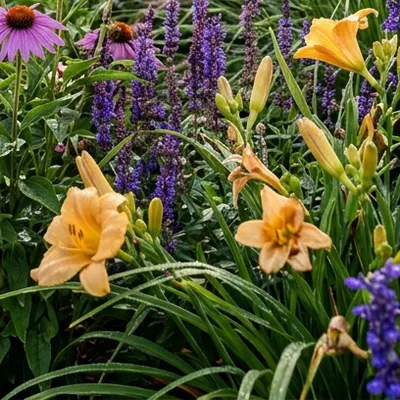
A dense zigzag planting spaced 12 inches apart using coneflowers, salvia, and ornamental grasses. Leaves spread to cover the ground and block weeds.

Sweet Corn Pollination Block
Corn needs wind to blow pollen between plants. A block of 5 short rows fills ears with sweet kernels much better than one long single row.

Slope Groundcover & Weed Barrier (Creeping Thyme)
A zigzag pattern spaced 8 inches apart using 410 small starter plugs to form a thick, living carpet that stops erosion and weeds in a single season.
Quick Plant Spacing & Density Chart
Recommended spacing for vegetables, flowers, perennials, and hedge shrubs based on university agricultural research. Search by plant name or filter by type.
| Plant | Space Between Plants | Space Between Rows | Best Layout | Source | Plan It |
|---|---|---|---|---|---|
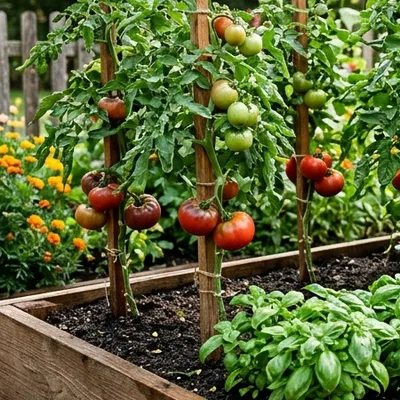 Bush Tomato Staked or Caged Bed | 18" (15–24") | 36" (30–42") | 18–24 in | University of Minnesota Extension↗ | |
 Climbing Tomato Trellis or Large Cage | 24" (18–36") | 42" (36–48") | 24–36 in | University of Minnesota Extension↗ | |
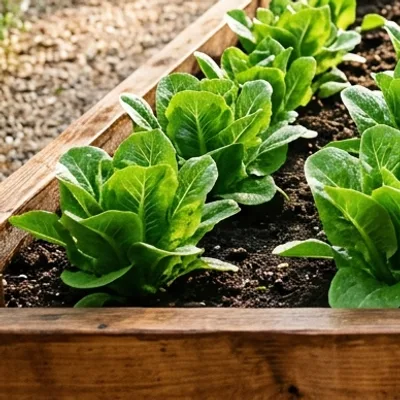 Head Lettuce (Romaine / Crisphead) Garden Bed | 12" (10–14") | 12" (12–18") | 10–12 in | University of Minnesota Extension↗ | |
 Carrots (Garden Bed) Raised Bed | 3" (2–4") | 3" (3–12") | 3–4 in | University of Minnesota Extension↗ | |
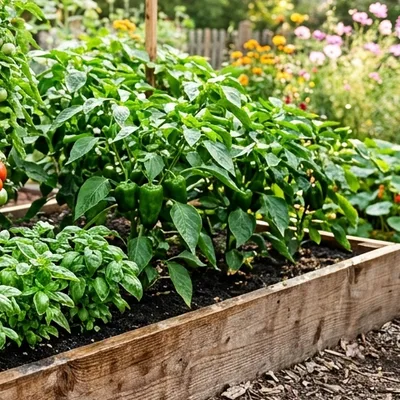 Bell & Sweet Pepper Garden Bed or Rows | 18" (14–24") | 18" (18–30") | 16–20 in | UF/IFAS Extension↗ | |
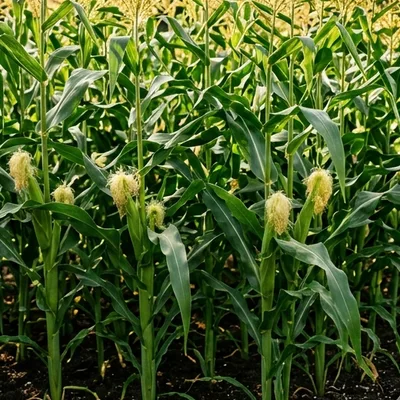 Sweet Corn Block Rows for Wind Pollination | 9" (8–12") | 30" (24–36") | 12–15 in | University of Minnesota Extension↗ | |
 Strawberry (Garden Bed) Raised Bed | 12" (10–14") | 12" (12–18") | 12–14 in | University of Minnesota Extension↗ | |
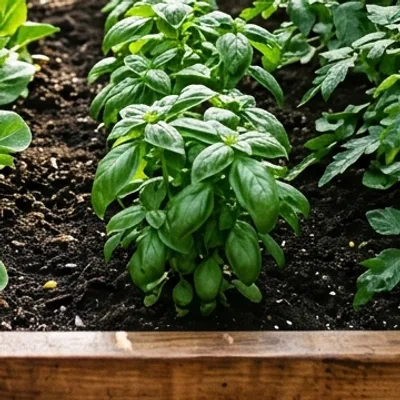 Sweet Basil Herb Bed / Garden Row | 10" (8–12") | 12" (10–18") | 10–14 in | University of Maryland Extension↗ |








Vegetable Plant Spacing
Bush tomatoes and compact vegetables can be planted closer together than large climbing varieties. Raised beds let you plant closer because you don't need wide walking paths between every row.
Herbs, Flowers, and Perennials
Space perennial flowers by their full-grown width so leaves gently touch once mature. This keeps weeds down while letting fresh air circulate.
Groundcovers and Low Shrubs
Groundcover starter plugs planted in a zigzag pattern fill in to form a dense green carpet faster than straight rows.
Hedges and Fruit Trees
Hedge spacing depends on how fast you want a solid privacy screen. Fruit tree spacing depends mainly on the tree size (dwarf, semi-dwarf, or standard).
How Many Plants Fit in a Garden Bed?
See how many plants fit in popular raised beds. The live map updates as you change bed sizes and plant spacing.
How Many Plants Fit in a Garden Bed?
Straight Rows vs. Zigzag PatternExact Plant Counts for Standard Beds (with edge space)View Table ↓
| Plant Spacing | Edge Space | 4×4 ft Bed | 3×6 ft Bed | 4×8 ft Bed (Straight / Zigzag) |
|---|---|---|---|---|
| 3 in (7.6 cm) | 1.5 in | 256 | 288 | 512 Sq / 567 Zigzag |
| 4 in (10.2 cm) | 2.0 in | 144 | 162 | 288 Sq / 318 Zigzag |
| 6 in (15.2 cm) | 3.0 in | 64 | 72 | 128 Sq / 135 Zigzag |
| 12 in (30.5 cm) | 6.0 in | 16 Sq / 14 Zigzag | 18 Sq / 16 Zigzag | 32 Sq / 30 Zigzag |
| 18 in (45.7 cm) | 9.0 in | 4 Sq / 6 Zigzag | 8 Sq / 7 Zigzag | 10 Sq / 13 Zigzag |
| 24 in (61.0 cm) | 12.0 in | 4 Sq / 3 Zigzag | 3 Sq / 4 Zigzag | 8 Sq / 7 Zigzag |
Planting Day Checklist: From Plan to Soil
5 simple steps to mark your garden: squaring your corners, cutting handy spacer sticks, and laying out straight rows.
Squaring Bed Corners Using the 3-4-5 Rule
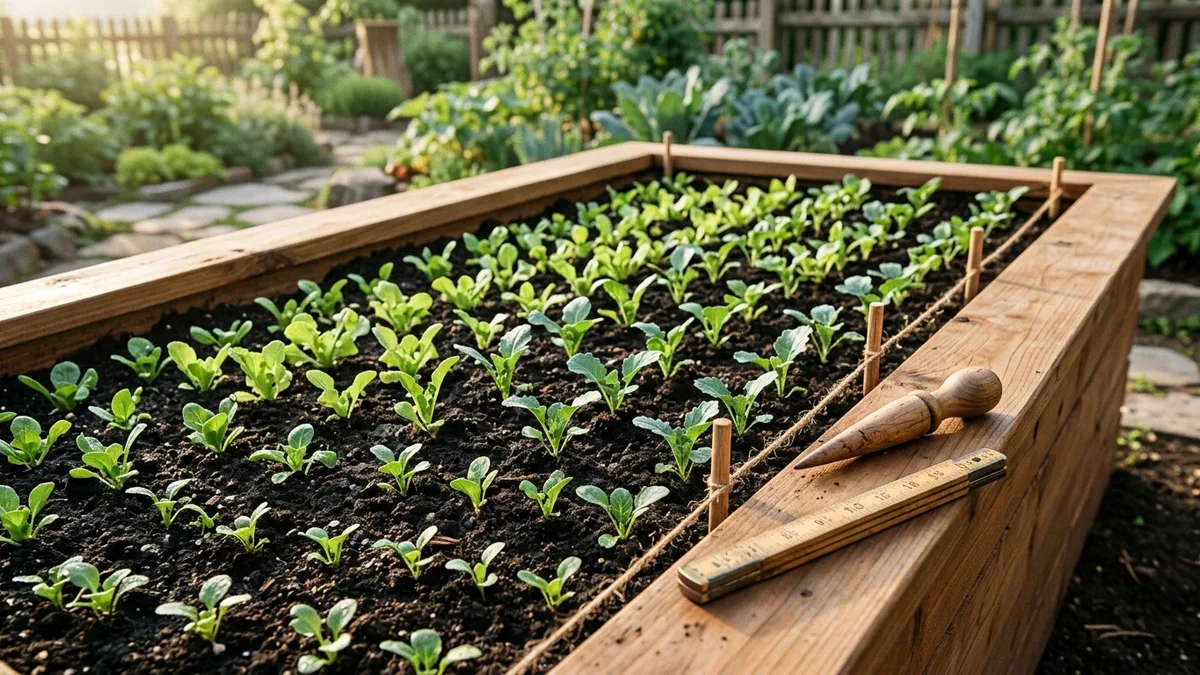
Squaring CornersIf your garden bed corners are crooked, rows will wander into the walls. Measure 3 feet along one side, 4 feet along the other side, and adjust until the diagonal across the corner is exactly 5 feet. That creates a perfect square corner.
Square Corners (3-4-5 Rule)
Measure 3 ft along one side and 4 ft along the other; when the diagonal is 5 ft, your corner is perfectly square.
Cut Handy Spacer Sticks
Cut a scrap stick to your plant spacing distance. Use it as a quick ruler to mark plant spots in seconds.
Shift Zigzag Rows
For a zigzag pattern, shift every second row by half a space and bring rows slightly closer together.
Avoid Stepping on Garden Soil
Stand on walkways or reach boards. Never step directly on fluffy, prepared garden bed soil.
Line Up Drip Watering
Place your drip hoses or watering emitters right next to plant stems before covering with mulch.
Companion Planting & Timed Harvests
Grow helper plants together and harvest fast crops (like radishes) in the empty spaces between slow-growing crops (like cabbage).
Plant Spacing for Pots, Grow Bags & Small Spaces
In containers, root space is what matters most. See how many vegetables and herbs fit in 5-gallon and 10-gallon pots.
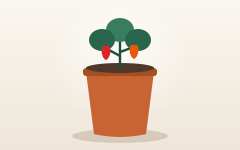
5-Gallon Bucket / Pot
The classic size for patio gardening. Great for one large vegetable or several small salad greens.

10-Gallon Fabric Grow Bag
Fabric bags let air reach roots, preventing roots from circling the pot and helping plants handle summer heat.

20-Gallon Large Planter
Holds plenty of soil to protect roots from hot summer temperatures. Great for mini companion groupings.
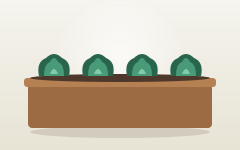
Window Boxes & Railing Planters
Shallow soil dries out fast. Best suited for kitchen herbs and shallow-rooted salad greens.
Companion Planting & Timed Harvests
Grow helper plants together and harvest fast crops (like radishes) in the empty spaces between slow-growing crops (like cabbage).
Main Vegetable & Harvest Timing↓
| Main Vegetable | Companion Plant | Distance Between Plants | Harvest Timing | How They Help Each Other |
|---|---|---|---|---|
| Tomato (Climbing / Vining) | Sweet Basil / Marigold | 12 in (30 cm) from stem | All summer long | Basil improves growth; marigolds help deter garden pests. |
| Cabbage / Broccoli | Radish / Baby Spinach | 6 in (15 cm) between heads | Harvested 45 days early | Radishes are harvested in just 3 weeks, before cabbage heads fill out. |
| Carrots (Slow to sprout) | Fast Radishes | Sown in the same row | Radishes sprout in 4 days | Quick radishes sprout first, breaking crusty soil and marking rows for slow carrots. |
| Sweet Corn (Block) | Climbing Green Beans | 6 in (15 cm) from corn base | Sown 3 weeks after corn | Beans climb sturdy corn stalks and enrich the soil with natural nitrogen. |
Explore More Garden Spacing Calculators
Helpful tools for raised beds, zigzag spacing, privacy hedges, plants per acre, and sweet corn blocks.
Raised Bed Spacing
Popular 4×8, 4×4, and custom bed templates with edge space visualization.
Zigzag Spacing Calculator
Zigzag planting pattern calculator comparing straight rows with zigzag layouts.
Square Foot Gardening
Easy square foot planner for 1, 4, 9, and 16 plants per square foot box.
Hedge Spacing Calculator
Single-row and double zigzag privacy hedge planner with space at the ends.
Groundcover & Starter Plugs
Calculate how many starter flats (32, 50, 72 plugs) you need to cover garden beds and slopes.
Plant Density Calculator
Convert plant spacing to plants per square foot, square meter, acre, or hectare.
Plants Per Acre & Hectare
Field crop plant count calculator for farm acreage, row spacing, and seed rates.
Sweet Corn Spacing Calculator
Block planting planner for sweet corn wind pollination and ear fill.
Plant Spacing Calculator FAQs
What does center-to-center plant spacing mean?+
Center-to-center spacing (often written as 'on-center') means measuring from the center stem of one plant to the center stem of the next plant. You measure stem-to-stem, not the gap between pot rims or leaf tips.
Why does a zigzag pattern sometimes fit fewer plants than straight rows in a garden bed?+
On paper, a zigzag pattern can fit up to 15% more plants across large open ground. But inside a real garden bed with borders, every second row is shifted inward to create the zigzag. That shift often means there isn't enough room for the last plant on the edge. For example, in a 4×8 ft bed with 6-inch edge spaces, zigzag rows hold 8, 7, 8, and 7 plants (30 total), while straight rows fit 32 plants (4 rows of 8).
What is the difference between plant spacing and row spacing?+
Plant spacing is the distance between plants along the same row. Row spacing is the distance from one row to the next. Rows are often spaced farther apart to give you room to walk, weed, and harvest easily.
How much space should I leave along the edges of my garden bed?+
A great rule of thumb is to leave half the normal plant spacing along the outer edges. For example, if plants need 12 inches between each other, leave 6 inches between the outer plants and the wall. This gives leaves and roots enough room without pressing against the walls or spilling into pathways.
How many extra plants should I buy as spares?+
It is smart to buy 5% to 10% extra plants (or one extra pack). This replaces any seedlings that get damaged, die after planting, or grow slowly, keeping your garden full and even.
Can I switch between feet/inches and meters/centimeters?+
Yes. Click the FT / IN or M / CM button at the top of the page anytime. All your garden measurements, edge spaces, and plant spacings will convert instantly.
How Our Calculator Works & Trusted Sources
Our tool places plants with exact measurements inside your garden walls, using proven spacing rules from top university agricultural programs.
Precision-tested math ensures clean, accurate plant counts on every screen.
Vegetable gardening and row spacing guides, covering tomatoes, sweet corn, peppers, and root crops.
extension.umn.edu →Hedge spacing guides for formal and informal privacy screens and evergreen shrubs.
rhs.org.uk/plants/types/hedges →Groundcover spacing tables, plug flat coverage, and perennial flower spacing guides.
extension.illinois.edu →Warm-climate gardening guidelines and fruit tree spacing by tree size.
gardeningsolutions.ifas.ufl.edu →